Last Updated on July 1, 2026 by Beth Skwarecki
Every denied claim that lands back in a billing system is also a record of something that went wrong further upstream, and that record sits there whether or not anyone reads it closely. The initial denial rate that revenue cycle teams watch has been climbing for several years, reaching close to twelve percent of first-pass claims by 2024 according to a widely cited annual survey of revenue cycle leaders, up from around ten percent only a few years earlier, and a growing share of providers now report that more than one in ten of their claims comes back unpaid.
What gets said far less often is that the same data trail documenting each of those denials also holds the pattern that could have prevented the next one, and the gap between an organization that quietly absorbs the loss and one that recovers it usually comes down to whether anyone is treating denials as a body of evidence rather than a stack of tickets to work one at a time.
What Your Denial Data Already Knows is That Your Team Has Not Asked It
A denial worked in isolation looks like a single problem to fix, but the same denials viewed in aggregate tend to reveal a structure that no individual claim could show. When you segment denials by payer, by the specific reason and remark codes attached to them, by service line, by the location or provider that generated them, and by the point in the cycle where they failed, the concentration becomes obvious in a way it never is at the claim level.
A handful of reason codes and one or two payers commonly account for a disproportionate share of the total, and the leading causes are remarkably consistent across the industry, with missing or inaccurate data, prior authorization problems, and incomplete patient information sitting near the top of nearly every analysis.
The first return on looking at denials analytically is simply seeing where they cluster, because you cannot prioritize a problem you have only ever encountered as scattered, individual events.
Moving From Counting Denials to Explaining Why They Happen
Knowing which denials occur most often is useful, but the recoverable value comes from understanding where each one originates. Diagnostic analysis traces a denial reason back to the step in the workflow that produced it, whether that was an eligibility check skipped at registration, a coding decision that did not match the documentation, an authorization that lapsed before the date of service, or a claim that simply missed a filing deadline.
A large proportion of denials begin at the front desk, where incomplete or inaccurate intake information quietly sets up a downstream rejection that surfaces weeks later as a payer response. Once you can connect a pattern of denials to the process that creates them, the response changes from reworking claims to repairing the workflow, and that is the point at which denial volume actually starts to fall rather than merely getting managed more efficiently.
Predicting Which Claims will be Denied Before They are Submitted
The most valuable shift is from cleaning up denials after the fact to catching them before a claim ever leaves the building. Models trained on an organization’s own historical claims can score new claims for denial risk at the point of submission, flagging the ones that resemble past failures so staff can correct them while correction is still cheap.
This is the difference between denial management and denial prevention, and the prevention side carries the higher return because so much of what gets denied is administrative rather than a genuine coverage dispute.
Industry benchmarks make that point clearly, with initial denial rates running several times higher than final denial rates once appeals run their course, which tells you that a substantial portion of denials were always preventable or overturnable and only cost the organization because they were caught too late. Predictive scoring puts the catch where it belongs, ahead of submission, instead of after a payer has already said no.
Why Recovered Revenue Depends on Prioritizing the Right Denials
Not every denial is worth the same effort, and pretending otherwise is how revenue cycle teams burn hours for very little return. Somewhere between a third and roughly two-thirds of denied claims are never reworked at all, and reworking one can cost anywhere from twenty-five dollars to well over a hundred, so the question is rarely whether a denial can be appealed but whether the expected recovery justifies the labor.
Analytics answers that question by triaging denials according to both their dollar value and their likelihood of being overturned, routing staff toward the claims where the return is real and away from the ones that will consume time without producing payment.
This is where analytics and a disciplined billing operation reinforce each other, because the analysis identifies the leak while strong healthcare revenue cycle management services supply the workflow, the payer knowledge, and the follow-through that closes it. One without the other leaves money on the table.
Building the Data Foundation that Makes Denial Analytics Possible
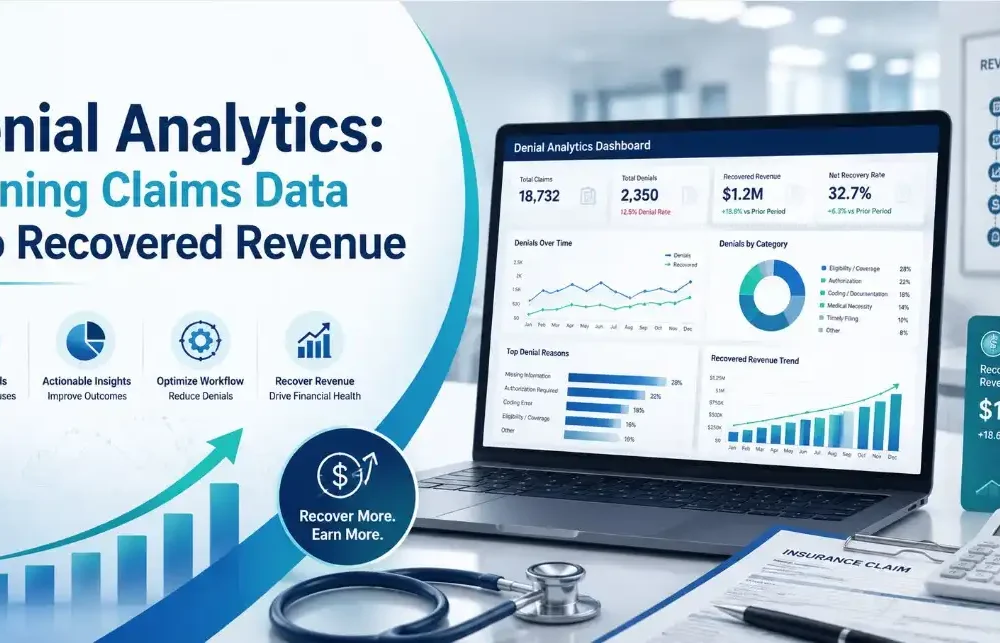
None of this works on top of messy or disconnected data, which is why the unglamorous groundwork matters as much as the models that sit above it. Useful denial analytics depends on clean, integrated claims and remittance data, a consistent denial taxonomy so that the same problem is not counted three different ways, and dashboards built around the metrics that genuinely move recovery, including first-pass and clean claim rates, denial rate broken out by reason and payer, days in accounts receivable, net collection rate, and the rate at which appealed denials are overturned.
Assembling that foundation and the predictive models on top of it is rarely something a billing team can do alongside its day job, which is why organizations increasingly lean on healthcare data analytics services to build the pipelines, define the taxonomy, and stand up the reporting that turns a backlog of denials into a source of intelligence. The investment tends to justify itself quickly, because the revenue it recovers was already earned and is only waiting to be collected.
The recovered revenue in question is not new business you have to go win. It is money the organization already produced and is currently signing away because the denials that document the loss are being worked instead of being read. Reading them, at scale and with the right tools, is how that revenue comes back.

Lizethe writes about the vital intersection of healthcare and law, breaking down complex legal topics into clear, practical insights. From patient rights to medical regulations, Lizethe helps readers understand the legal side of health, empowering them with knowledge to protect and advocate for themselves.